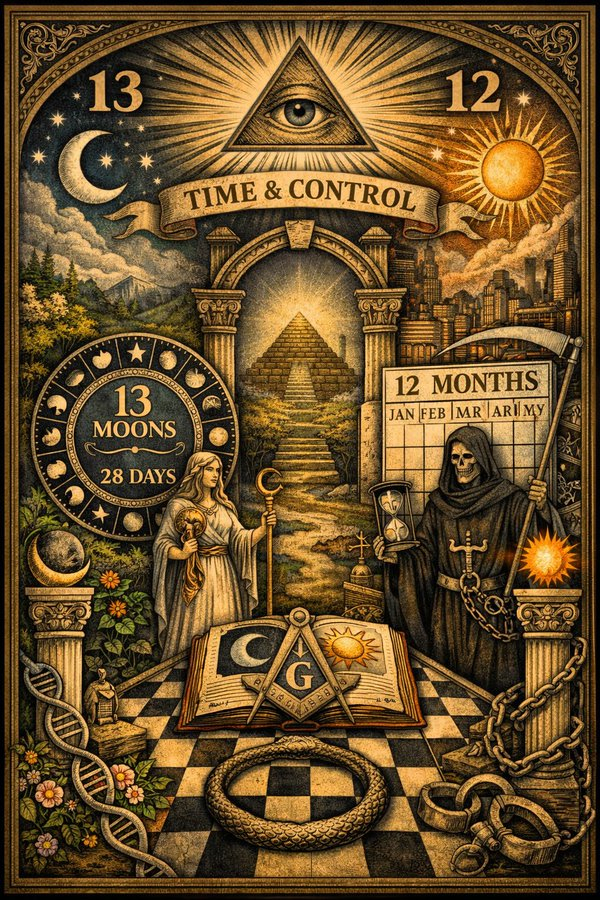
有人问,如果我们把日历从13个月的日历改成4个月的日历,会有什么影响?好,我们来看看吧?它彻底改写了你对人类睡眠、荷尔蒙周期、围绕太阳季节演化的季节性情感模式、昼夜节律、超昼夜节律、次昼夜节律、季节性神经化学变化(褪黑激素、血清素、多巴胺)的认知。人类并非太阳月周期生物。我们是七日周期(7天)和二十八日周期(28天)生物。与激素调节(尤其是皮质醇和生殖激素)、免疫系统周期、较长时间的睡眠结构、神经递质补充模式、组织再生节律相关的关键系统。目前,月份的天数在28到31天之间。周与月并不完全对应。周期会随着工作、收入和压力而不断变化。这类似于轮班工作紊乱症或慢性时差反应。导致基础皮质醇水平升高、恢复不良、炎症标志物增加、睡眠/觉醒稳定性紊乱、激素不稳定(男性和女性)。严格的28天日历周期将与月份一致。这样可以进行跟踪、休息和工作量调整。在12个月的周期制度下,各种周期无休止地跨越数月。缺乏稳定的社会节奏来支持恢复或适应。工作预期仍然是线性的,而生物节律却是周期性的。这种错位导致经前焦虑症病情加重、生育压力增大、激素紊乱被视为“个体病理”而非系统性错位。昼夜节律和七日节律之间的冲突被称为“七日陷阱”。纵观历史,我们一直生活在昼夜交替(昼夜节律)、一周周期节律(七日节律)和与月亮相关的周期(月相周期)之中。格里历保留了周的概念,打破了月与周的关系。这导致每周的开始和结束都在人为的月度压力周期内,因此在大的时间尺度上没有清晰的“休息-重置”关系。在13个月/28天的周期系统中,每个月正好等于4周。恢复节奏可预测,生物节律清晰。现代社会普遍存在的职业倦怠问题,部分原因是时间结构问题,而不仅仅是工作量问题。压力不仅仅是情绪上的,它也具有时间性。12个月的周期制度造成了月份不均衡、需求不均以及截止日期随意设定。你的神经系统不会感受到“现在是二月,一个较短的月份”,而是会感受到“恢复时间又被缩短了”。这进一步强化了交感神经系统的优势地位,并缩短了副交感神经的恢复窗口。数十年后,这会表现为自身免疫性疾病、代谢功能障碍、焦虑症、抑郁症和慢性疲劳综合征。这些症状并非完全由日历因素引起,但日历因素会加剧这些症状。历法的改变与帝国的扩张、债务体系的扩张以及雇佣劳动取代季节性工作,这难道不是巧合吗?随着社会等级制度的日益森严,时间从自然中抽象出来,并围绕行政管理进行了重新构建。12 个月的系统训练对外部环境的依赖性,以培养时间定向能力。现代人需要应用程序来告诉他们日期。我们感觉时间“流逝”。我们失去了对季节的感知。这并非因为我们愚笨,而是因为我们不再能真切地感受到时间,而只是通过某种方式来感知它。规律的 28 天节律在内部是可预测的,可以从身体上感受到,而且不那么抽象。除此之外,没有其他区别。Someone asked what would it matter if they changed our calendar from the 13 month calendar? Well, let's see shall we?It completely rewrites your reality in terms of human sleep, hormonal cycles, seasonal affective patterns evolved around solar seasons, circadian rhythms, ultradian rhythms, infradian rhythms, seasonal neurochemical shifts (melatonin, serotonin, dopamine)Humans are not solar-monthly organisms. We are circaseptan (7-day) and circalunar (28-day) organisms.Key systems tied to hormonal regulation (especially cortisol and reproductive hormones), immune system cycling, sleep architecture over longer spans, neurotransmitter replenishment patterns, tissue regeneration rhythms.Right now, months range from 28–31 days. Weeks do not align cleanly with months. Cycles constantly shift relative to work, pay, and stress.This is similar to shift-work disorder or chronic jet lag.Resulting in elevated baseline cortisol, poor recovery, increased inflammation markers, dysregulated sleep/wake stability, hormonal instability (men and women).Under a strict 28-day calendar cycles would align with months. Tracking, rest, and workload adaptation would be possible.Under the 12-month system, cycles drift through months endlessly. No consistent societal rhythm supports recovery or adaptation. Work expectations remain linear while biology is cyclical.This misalignment contributes to PMDD severity, fertility stress, hormonal disorders being treated as “individual pathology” instead of systemic misalignment.The Circadian and Circaseptan conflict is known as the 7-Day Trap. Throughout history we have always lived with day/night (circadian), week length rhythms (circaseptan) and moon linked cycles (circalunar). The Gregorian calendar preserves the week and breaks the month-week relationship.This causes weeks that start and end inside artificial monthly stress cycles so there is no clean “rest-reset” relationship at larger time scales.In a 13-month / 28-day system every month equals exactly 4 weeks. Predictable recovery rhythms and clear biological pacing.The modern burnout epidemic is partly due to time structure, not just workload.Stress isn’t just emotional, it’s temporal. The 12-month system creates uneven months with unequal demands, and arbitrary deadlines. Your nervous system doesn’t experience "It’s February, a short month", it experiences "Recovery time was shortened again."This reinforces a sympathetic nervous system dominance, and reduced parasympathetic recovery windows.Over decades, this shows up as autoimmune conditions, metabolic dysfunction, anxiety disorders, depression, and chronic fatigue syndromes. Not caused by the calendar alone but amplified by it.Is it no coincidence that the changing of the calendar coincides with expansion of empire, debt systems, and wage labor replacing seasonal work?As societies became more hierarchical, time was abstracted away from nature and restructured around administration.The 12-month system trains external dependence for temporal orientation.Modern people need apps to tell them dates. We feel time “slipping." We have lost seasonal intuition. This isn’t because we’re dumb, it's because time is no longer felt, only referenced.A regular 28-day rhythm would be internally predictable, felt somatically and be less abstract.Other than that, no, it doesn't make a difference.

![有没有可能只是在生闷气[6]](http://image.uczzd.cn/6158215429752380320.jpg?id=0)
![连夜造谣,也不容易,不久后该说,委瑞内拉要成发达国家了。[捂脸哭]](http://image.uczzd.cn/17878502909917935042.jpg?id=0)